What Are the Top Types of Water Jet Rubber Hose?

Choosing the right water jet rubber hose begins with pressure, temperature, and working conditions. A hose that looks strong may still fail under repeated pulses, sharp bends, or abrasive water. The outer cover, reinforcement layers, tube compound, and coupling design all deserve close attention. Small details matter.

John H. Haskins, a water-jetting safety educator, puts it plainly: “The hose is part of the pressure system, not merely a flexible connection.” That view shapes this guide. We examine high-pressure water jet hoses, ultra-high-pressure hoses, sewer jetting hoses, flexible washdown hoses, and specialized abrasive-resistant options. Each type serves a different job. Some favor flexibility. Others prioritize burst resistance or surface durability. None is perfect.

Real selection requires more than reading a pressure number. Operators should check the working pressure, safety factor, minimum bend radius, fluid temperature, connection compatibility, and visible wear. A hose dragged across concrete needs different protection from one used inside a clean workshop. Pay attention to cuts, blisters, exposed reinforcement, crushed sections, and stiffened rubber. Replace damaged hose early. It is cheaper than a sudden shutdown.

There is no universal “best” hose. That answer sounds convenient, but it is incomplete. This article compares the leading types of water jet rubber hose and explains where each performs reliably. It also questions common buying habits, including choosing by price alone. Certification, traceability, inspection records, and trained handling should remain part of the decision. The final choice must match the equipment, application, and manufacturer’s instructions.
What Are the Top Types of Water Jet Rubber Hose?

Classify Water Jet Rubber Hoses by Working Pressure: 3,000–40,000 psi

Water jet rubber hoses are commonly classified by working pressure, from 3,000 to 40,000 psi. A 3,000 psi hose suits light surface cleaning, equipment washing, and general maintenance. These hoses are usually flexible and easier to handle around pumps and narrow work areas.

At 5,000 to 10,000 psi, hoses support tougher cleaning tasks, including concrete preparation and heavy industrial deposits. Their rubber cover must resist abrasion, oil contact, and repeated bending. At 20,000 psi, the hose construction becomes more specialized. Reinforcement layers, fitting design, and minimum bend radius require careful checking. A 40,000 psi hose belongs to an ultra-high-pressure class. It may use a compact composite structure rather than ordinary rubber alone. Never treat it like a standard washdown hose.

Pressure is not everything. Temperature, fluid compatibility, impulse cycles, and connector condition also affect service life. Field inspections often find damage near fittings, where the hose bends sharply or rubs against steel edges. Small details matter. The rated working pressure must exceed the pump’s operating pressure, while the burst rating should remain clearly higher. Some selection decisions still rely too heavily on pressure numbers. That approach can fail when the hose is twisted, overheated, or installed below its recommended bend radius. Before operation, check the pressure marking, cover condition, coupling security, and inspection date. A qualified technician should replace any hose showing cuts, exposed reinforcement, swelling, or abnormal stiffness.

High-Pressure Cleaning Hoses: 3,000–10,000 psi and 60–150°C Ratings

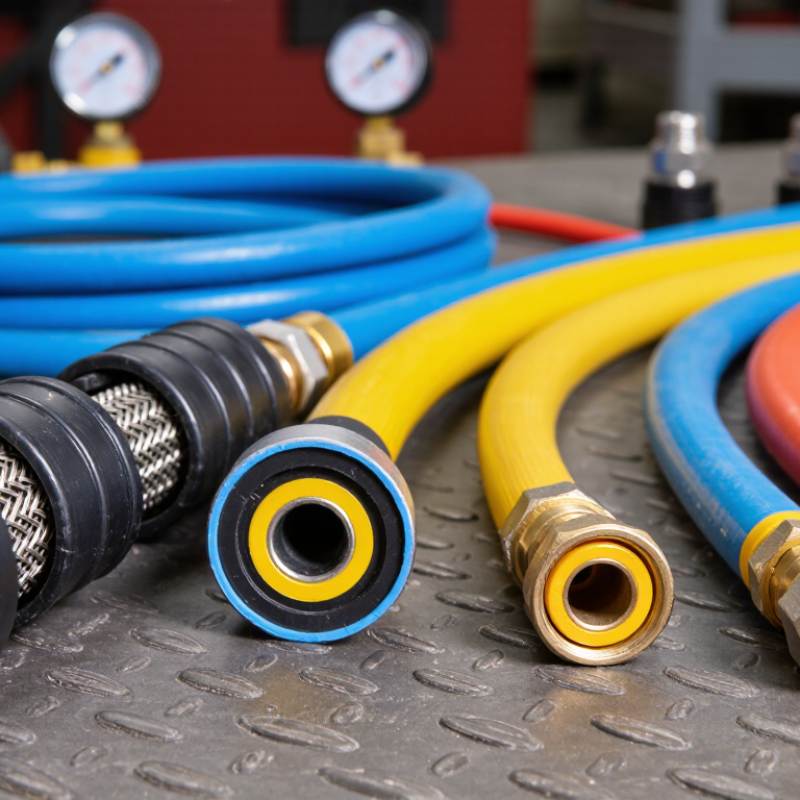
Water-jet rubber hoses are usually divided by reinforcement: textile-braided, wire-braided, and multi-spiral wire designs. For cleaning systems rated from 3,000 to 10,000 psi, multi-spiral rubber hoses offer stronger pressure resistance and better impulse performance. Wire-braided hoses remain useful at lower pressures and tighter bends. Textile hoses are lighter, but their pressure margin is usually smaller.

Temperature changes the selection. A hose rated for 10,000 psi at 20°C may not keep that rating at 150°C. Steam, hot water, and chemical detergents can harden the tube or weaken the cover. EN 1829-2:2023 addresses safety requirements for high-pressure water-jetting hoses and assemblies. ISO 7751:2016 also defines pressure relationships for testing hose assemblies. These standards support a practical rule: confirm working pressure, test pressure, burst pressure, and temperature separately. Do not treat one rating as universal.

Field technicians often inspect the first metre near the lance, where flexing and heat are severe. A 60°C hose may suit routine washing, while 100–150°C service needs heat-resistant rubber and compatible fittings. The Water Jetting Association’s recommended practices emphasize inspection, guarding, and controlled pressure release. A hose can look clean and still be unsafe. That is the uncomfortable part. Manufacturers’ tables may also differ, so selecting only by psi is incomplete. A safer specification records pressure, temperature, bend radius, fluid, coupling type, and inspection interval.

Ultra-High-Pressure Hoses: 20,000–40,000 psi for Industrial Water Jetting

At 20,000–40,000 psi, water jetting demands more than a thick rubber tube. The hose needs layered reinforcement, a pressure-rated inner tube, and a cover resistant to abrasion, water, and oil mist. During field inspections, I look for crushed sections, exposed braid, and stiff bends before checking the pressure tag. Small surface damage can hide serious fatigue. Pressure changes everything.

A reliable ultra-high-pressure hose must match the pump’s working pressure, not merely its burst rating. Engineers should confirm internal diameter, connection type, temperature range, minimum bend radius, and pulse frequency. At these pressures, fittings are not secondary parts; they are part of the pressure system. Keep hose runs straight near couplings, secure them against whipping, and inspect them after every demanding shift. A worn cover may still look usable. That is where judgment can fail. Repeated flexing can weaken a hose near a coupling, while the damage remains hidden beneath the outer cover.

For industrial water jetting, choose a hose with traceable test records and clear identification. Verify its rated working pressure under the actual water temperature and operating cycle. Do not substitute a lower-rated hose because it fits the same connector. Operators should use shields, remote controls, and documented inspection intervals. Certification helps, but it does not replace a hands-on check.

What Are the Top Types of Water Jet Rubber Hose? — Ultra-High-Pressure Hoses: 20,000–40,000 psi for Industrial Water Jetting
Hose Type Typical Working Pressure Approx. Pressure in Bar Typical Internal Diameter Construction Recommended Water-Jetting Uses Typical Temperature Range Main Advantages
20,000 psi Multi-Spiral Rubber Hose 20,000 psi Approximately 1,380 bar 1/4–3/8 in Synthetic rubber inner tube with several layers of high-tensile steel wire spiral reinforcement and a durable abrasion-resistant rubber cover. Industrial surface preparation, paint and coating removal, concrete cleaning, general water blasting, and medium-duty descaling. Typically 0–60°C, subject to the hose manufacturer’s specification and water chemistry. Good balance of pressure capacity, flexibility, service life, and manageable hose weight.
20,000 psi Compact-Flexible Hose 20,000 psi Approximately 1,380 bar 3/16–1/4 in Compact synthetic rubber tube with high-strength wire reinforcement arranged to reduce outside diameter and improve routing flexibility. Hand-held water jetting, confined areas, short hose runs, equipment cleaning, and mobile maintenance systems. Typically 0–60°C; verify compatibility when using heated water or chemical additives. Smaller bend envelope and lower handling effort than heavier multi-layer hose constructions.
30,000 psi Heavy-Duty Multi-Spiral Hose 30,000 psi Approximately 2,070 bar 1/4–3/8 in Multiple layers of high-tensile steel wire over a fluid-resistant synthetic rubber tube, protected by a thick abrasion-resistant cover. Heavy-duty descaling, tube and pipe cleaning, shipyard maintenance, industrial cleaning, and difficult coating removal. Typically 0–60°C; higher temperatures require a hose specifically rated for hot-water service. Higher pressure capability and strong resistance to external abrasion and repeated industrial handling.
30,000 psi Small-Bore Jetting Hose 30,000 psi Approximately 2,070 bar 1/8–1/4 in Fine-bore rubber or thermoplastic-rubber tube with high-strength wire reinforcement, designed to limit pressure loss while maintaining a compact profile. Small-diameter pipe cleaning, precision water jetting, narrow access points, and applications requiring a long reach with a lightweight hose. Typically 0–60°C, depending on the tube compound, cover material, and assembly rating. Lower fluid volume, compact dimensions, and improved access in restricted spaces.
40,000 psi Ultra-High-Pressure Hose 40,000 psi Approximately 2,760 bar 1/8–1/4 in Specialized high-strength rubber or rubber-compatible inner tube with several layers of fine high-tensile steel wire reinforcement and a protective outer cover. Ultra-high-pressure water blasting, precision surface preparation, severe descaling, hydrodemolition support work, and specialized industrial cleaning. Typically 0–60°C; the exact limit depends on the complete hose assembly, fittings, and operating fluid. Very high pressure capability in a relatively small bore for demanding industrial jetting equipment.
40,000 psi Short-Length Whip Hose 40,000 psi Approximately 2,760 bar 1/8–3/16 in Flexible high-pressure hose section with high-strength wire reinforcement, normally used between rigid piping, a lance, or a jetting tool. Operator-side connections, lance assemblies, robotic water-jetting equipment, and installations requiring controlled movement near the nozzle. Typically 0–60°C; use only within the assembly’s stated pressure, temperature, and bend-radius limits. Improves connection flexibility and reduces transmission of movement to rigid components.
High-Visibility Abrasion-Resistant Hose 20,000–40,000 psi Approximately 1,380–2,760 bar 1/8–3/8 in Ultra-high-pressure rubber hose with a brightly colored, abrasion-resistant cover and optional protective sleeves or external guards. Construction sites, shipyards, maintenance platforms, demolition areas, and other environments where hose identification and surface protection are important. Typically 0–60°C; confirm the rating for sunlight, chemicals, and hot-water exposure. Improved visibility, easier inspection, and enhanced protection against scuffing and external wear.
Selection note: These are representative industry ranges rather than universal ratings. Always verify the complete hose assembly’s working pressure, burst pressure, temperature rating, minimum bend radius, fitting compatibility, and applicable safety requirements before use. Never exceed the lowest-rated component in the system.

Sewer-Jetting Rubber Hoses: 1/2–2 in IDs and 150–300 m Working Lengths

What Are the Top Types of Water Jet Rubber Hose?

Sewer-jetting rubber hoses commonly range from 1/2 to 2 inches in inside diameter. Smaller 1/2-inch and 3/4-inch hoses suit narrow drains and compact cleaning equipment. They are flexible, lighter to handle, and easier to guide through tight bends. A 1-inch hose offers a practical balance between flow and maneuverability. That balance matters.

For larger municipal lines, 1-1/2-inch and 2-inch hoses can carry greater water volume. Their heavier construction supports demanding cleaning cycles, but operators need suitable reels and lifting equipment. Working lengths usually range from 150 to 300 meters. Long runs reduce coupling interruptions, yet they also increase weight, friction, and pressure loss. A longer hose is not automatically better.

Construction details affect daily performance. A smooth inner tube helps maintain flow, while a reinforced textile layer controls expansion under pressure. A durable outer cover resists abrasion against concrete, metal edges, and wet pavement. The minimum bend radius deserves attention, especially near the reel and nozzle connection. Tight bends can damage reinforcement before visible cracks appear.

Technicians should match the hose to operating pressure, water temperature, nozzle size, and reel speed. Couplings must be correctly crimped and inspected before every shift. Look for blistering, exposed reinforcement, flattened sections, or unusual stiffness. One overlooked weakness can become serious. Pressure ratings also require a safety margin, not a guess based on yesterday’s job. Manufacturer data and documented inspection records provide more reliable guidance than appearance alone.

Compare Hose Reinforcement, Bend Radius, and Safety Factors Under ISO 18752

What Are the Top Types of Water Jet Rubber Hose?

Choosing a water jet rubber hose starts with reinforcement, not appearance. Wire-braided hoses suit moderate pressure and frequent handling. Spiral-wire designs usually support higher pressure and heavier duty cycles. Textile reinforcement can improve flexibility, but it may offer less resistance to severe pressure pulses. In practical inspections, I look for exposed wires, cover cuts, and crushed sections near fittings. Small damage can become a serious failure point.

ISO 18752 helps compare hose performance through pressure classes, temperature limits, and dimensional requirements. It does not make every hose suitable for water jetting. Confirm the stated working pressure, test records, and assembly compatibility. The safety factor should separate normal working pressure from burst pressure. Never treat burst pressure as an operating target. Actual risk also depends on pressure spikes, water temperature, coupling quality, and operator distance. A conservative selection is often cheaper than replacing damaged equipment.

Bend radius deserves equal attention. A hose may meet its pressure rating yet fail early when bent too tightly. Measure the radius from the inside of the curve, especially beside the coupling. A larger radius reduces kinking and protects reinforcement wires. Temporary twisting is easy to miss. I have seen hoses stored in neat coils that still carried hidden torsion. That detail deserves more attention during inspections. Use restraints where movement could cause whipping, and replace assemblies when reinforcement, fittings, or covers show clear deterioration.

Top Types of Water Jet Rubber Hose

Reinforcement, minimum bend radius and reference safety factor for common high-pressure hose constructions

Hose construction Typical working pressure Reinforcement Minimum bend radius Reference safety factor
Single-wire braid 250 bar 1 steel-wire braid 5 × hose outside diameter 4.0:1
Two-wire braid 400 bar 2 steel-wire braids 6 × hose outside diameter 4.0:1
Four-wire spiral 700 bar 4 spiral wire layers 7 × hose outside diameter 4.0:1
Six-wire spiral 1,000 bar 6 spiral wire layers 8 × hose outside diameter 4.0:1

Braided constructions generally offer better flexibility, while spiral-reinforced hoses support higher working pressures but usually require a larger bend radius. The 4.0:1 value is shown as a common burst-to-working-pressure design benchmark; ISO 18752 performance, pressure class, impulse requirement and actual bend radius must be confirmed from the hose design and test documentation.