
What Are the Top Types of Industrial Ventilation Fans?
Choosing an Industrial Ventilation Fan is not simply a matter of selecting the highest airflow rating. A factory may need general exhaust, local source capture, heat removal, or pressure control. Each purpose changes the correct fan design.
Industrial ventilation authority Dr. John DallaValle stated, “The purpose of local exhaust ventilation is to remove contaminants at their source.” That principle still guides practical fan selection. A welding station may require a centrifugal fan connected to a carefully positioned hood. A warehouse may benefit from large axial fans that move air across wide spaces. A dusty process can demand abrasion-resistant construction, stronger pressure performance, and easier maintenance access.
The main types include axial fans, centrifugal fans, mixed-flow fans, propeller fans, roof exhaust fans, and tube axial fans. Axial models usually move large air volumes with modest pressure. Centrifugal models often handle duct resistance more effectively. Mixed-flow designs occupy a useful middle ground. Roof fans can simplify building exhaust, but weather exposure deserves attention.
The details matter.
In real facilities, noise, vibration, corrosion, motor efficiency, fire safety, and cleaning requirements can change the final choice. An undersized fan may leave visible haze near a machine. An oversized fan may waste energy and disturb conditioned air. I would not claim that one design is universally best. Fan performance depends on system resistance, contaminant behavior, operating temperature, and installation quality.
This guide compares the top Industrial Ventilation Fan types, explains their strengths, and highlights practical limitations. It also considers maintenance realities, because a technically excellent fan can still fail when access is difficult or inspections are neglected.
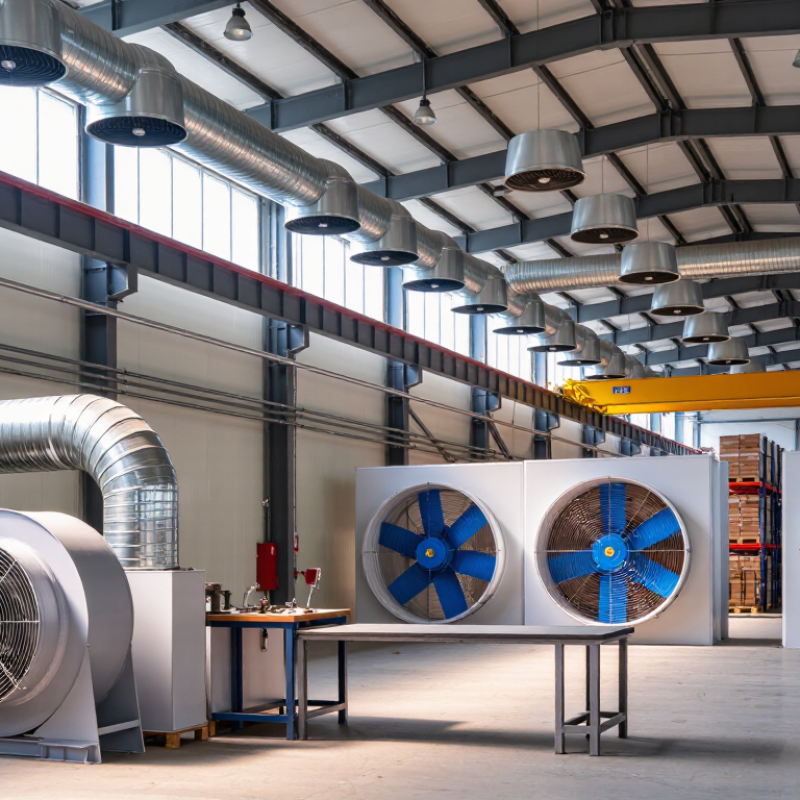
How Industrial Ventilation Fans Are Classified
Industrial ventilation fans are commonly classified by airflow direction, pressure range, and installation design.
Axial fans move air parallel to the shaft, much like a propeller pushing air through a wall or duct. They suit high-volume airflow when resistance is relatively low.
Centrifugal fans turn air outward from an impeller, then guide it into a housing. This design can handle higher system resistance, such as long duct runs or filters.
There are more categories. Mixed-flow fans combine features of axial and centrifugal designs, offering a middle ground for airflow and pressure.
Roof fans, wall fans, and duct fans describe where units are installed, rather than how they move air. That distinction matters when comparing equipment.
A roof-mounted axial fan and a duct-mounted centrifugal fan may serve very different systems. Not always a neat classification.
Fans may also be grouped by duty, including supply, exhaust, or smoke and heat removal. The correct category depends on the air volume, pressure losses, temperature, and contaminants involved.
Measure the duct layout and check the operating conditions before choosing. A fan that looks powerful on paper can still perform poorly if its pressure rating does not match the system.
Classification helps narrow the options, but real installation details deserve a second look.
What Defines Centrifugal Ventilation Fans?
Centrifugal ventilation fans move air by converting rotational energy into pressure. Air enters axially, then exits radially through the impeller. The curved blades create velocity, while the housing converts velocity into useful static pressure. This design suits factories with ducts, filters, dampers, and long exhaust routes.
Performance depends on more than airflow. Fan selection requires volume flow, static pressure, air temperature, density, noise, and operating hours. For example, moving 10,000 cubic meters per hour at 1,500 pascals requires about 4.17 kilowatts of air power. At 70% total efficiency, electrical demand approaches 5.95 kilowatts. Actual results can worsen when filters become dirty. That detail is often underestimated.
The International Energy Agency reported in Energy Efficiency 2023 that electric motor systems consume about 53% of global electricity. Fan systems form an important part of that demand. AMCA Standard 210 and ISO 5801 define recognized methods for measuring fan airflow and pressure. These standards improve comparison, but field conditions still matter. A certified test point cannot fully represent a dusty workshop. I have seen otherwise careful designs lose efficiency through undersized ducts, sharp elbows, and poorly adjusted dampers. The impeller is only one part of the system.
Where Are Axial Ventilation Fans Used?
Axial ventilation fans are widely used where large air volumes must move across short distances. Their blades push air parallel to the shaft, making them practical for factories, warehouses, tunnels, and livestock buildings. They work well in wall-mounted exhaust systems, roof extractors, and air-supply units. However, they are less suitable for long ducts or high-resistance filters.
The International Energy Agency reports that electric motor systems consume about half of global electricity. Fans are part of this energy challenge. In manufacturing plants, axial units can remove welding fumes, heat, dust, and humid air when the system is correctly designed. U.S. OSHA ventilation guidance also stresses capturing contaminants near their source, not simply moving polluted air around the room. That distinction matters. A powerful fan can still create poor indoor air quality.
Tips: Check airflow, static pressure, noise, and operating temperature before selection. Use a calibrated airflow hood or anemometer during commissioning. Keep guards, belts, and electrical controls accessible for inspection. Variable-speed control may reduce energy use, but only when sensors and controls are tuned properly. The IEA notes that efficient motor systems can deliver major savings, yet real installations often lose performance through blocked grilles, dirty blades, or incorrect balancing. Field experience suggests maintenance is not glamorous, but it decides whether axial ventilation remains effective. There is no universal fan choice.
What Are the Top Types of Industrial Ventilation Fans? — Where Are Axial Ventilation Fans Used?
| Fan Type | How Air Moves | Common Industrial Applications | Typical Strengths | Selection Considerations |
|---|---|---|---|---|
| Propeller Axial Fan | Air flows parallel to the fan shaft through a propeller-like blade assembly. | Wall or roof exhaust, general building ventilation, cooling large spaces, and supplying or removing air where duct resistance is low. | Moves large air volumes with a relatively simple, compact arrangement. | Best suited to low-resistance systems; performance can fall when connected to restrictive ductwork or filters. |
| Tube Axial Fan | An axial impeller is housed in a cylindrical casing, with air traveling along the casing. | Inline duct ventilation, process-area exhaust, and supply or exhaust systems with moderate duct resistance. | Fits directly into duct runs and can provide more system pressure capability than an unenclosed propeller fan. | Check the fan curve against the complete system resistance, including ducts, bends, dampers, and filters. |
| Vane Axial Fan | Air passes through an axial impeller and stationary guide vanes that help straighten the airflow. | Longer duct systems, industrial process ventilation, and applications requiring more pressure capability than basic axial arrangements. | Guide vanes can improve airflow direction and pressure performance in a compact inline design. | Consider noise, operating point, installation clearances, and the pressure losses of connected equipment. |
| Centrifugal Fan | The impeller draws air into its center and discharges it outward, generally at an angle to the inlet direction. | Dust collection, fume extraction, boiler and process systems, and duct networks with substantial resistance. | Often suitable for higher-pressure systems and can be configured for different air and material-handling duties. | Impeller design and materials should match the air temperature, particulate load, and any corrosive or abrasive conditions. |
| Mixed-Flow Fan | Air follows a combined axial and centrifugal path through the impeller. | Inline ventilation where space is limited and a balance of airflow and pressure is needed. | Can offer a compact alternative when a simple axial fan does not provide enough pressure for the system. | Compare its certified performance curve and sound characteristics with the actual system requirements. |
How Do Mixed-Flow Fans Combine Key Features?
Mixed-flow fans combine axial and centrifugal characteristics. Their impellers move air along the shaft and outward across the blades. This design can provide more static pressure than a comparable axial fan while keeping a relatively compact, straight-through layout. It can suit ducts, filters, and heat exchangers that create resistance. But “hybrid” does not automatically mean efficient; blade geometry and the system curve matter.
Choose a fan using required airflow and total pressure, not free-air figures alone. The U.S. Department of Energy’s 2003 Improving Fan System Performance: A Sourcebook for Industry reports that fans and blowers use about 15% of electricity consumed by U.S. industrial motor systems. Operating point and controls therefore matter. A mixed-flow unit may work well on a drying line or equipment enclosure, yet poor sizing can bring excess noise, power use, or unstable airflow. Field conditions are messy. Verify performance at the actual duty point.
Tips: Check the fan curve against dirty-filter pressure, not only clean conditions. Confirm motor input, sound limits, and cleaning access. If demand varies, assess speed control and verify the minimum stable speed. Airflow is not pressure.
What Factors Determine the Right Fan Type?
Choosing an industrial ventilation fan starts with the air, not the catalog label. Measure required airflow in cubic feet per minute and estimate system resistance in inches of water gauge. A dusty grinding area may need a robust centrifugal fan, while a large warehouse often suits an axial fan for high-volume movement. They are not interchangeable. I have seen installations fail because airflow was calculated without accounting for filters, elbows, dampers, or long ducts. Small details matter.
The contaminant decides more than people expect. Corrosive vapor, oily mist, wood dust, and hot exhaust demand different materials, seals, and motor arrangements. For explosive atmospheres, equipment must be selected and installed under applicable safety requirements by qualified professionals. Temperature also changes the choice; a fan moving 180°C air cannot be treated like a room ventilator. Moisture and washdown exposure may require protected housings and drainage. Check sound levels near occupied workstations, not only beside the fan.
Space and maintenance shape the practical answer. A roof exhaust fan may simplify ductwork, while a belt-driven unit can offer service flexibility but needs guarded access and routine inspection. Direct-drive designs reduce some maintenance, though they may limit adjustment options. Ask whether technicians can reach bearings, belts, filters, and isolation mounts safely. Energy use deserves a real operating-point review, because an oversized fan can waste power and create drafts. I would also verify measured airflow after commissioning; design figures sometimes look better than field conditions.

